
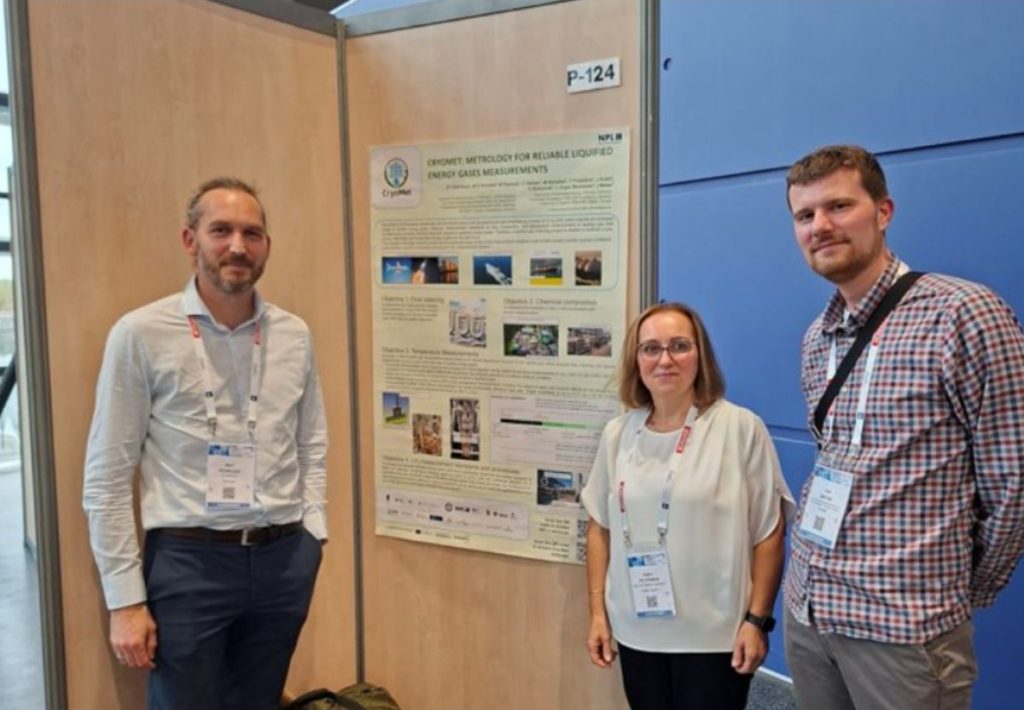
The CryoMet project was presented at the Joint International Symposium on Temperature, Humidity, Moisture, and Thermal Measurements in Industry and Science (TEMPMEKO ISMH Symposium 2025), held in Reims, France, from October 20 to 24. The project, which aims to develop reliable and traceable measurement methods for liquid energy gases, took the opportunity to showcase some of its key initiatives.
The project was represented by Radka Veltcheva, Senior Research Scientist at the National Physical Laboratory (NPL), and other representatives of work package 3 of the project, which focuses its efforts on determining the accuracy of (bio-)LNG in-field temperature measurements, including the impact of static and dynamic effects on the temperature measurement system. The presentation consisted of a poster displayed at the event that reviewed several of the project’s objectives.
The first objective displayed refers to creating knowledge about the measurement reliability and uncertainty of (bio-)LNG flow meters in field conditions. Second, the partners showed how the consortium is determining the reliability of (bio-)LNG composition and density measurements. The third objective analysed the need for accurate in-field liquefied gas temperature measurements. Last, the poster explained how CryoMet will create new facilities for in-field temperature sensor calibration, to cover the existing gap on NMIs to calibrate temperature sensors down to -253 °C (LH2).
CryoMET’s participation in TEMPMEKO – ISHM 2025, organised by the French National Conservatory of Arts and Crafts, highlights the key role of WP3 in promoting reliable thermal measurement for liquid energy gases. These types of scientific presentations are essential for strengthening collaboration between metrologists, industry, and regulators, and for accelerating the safe deployment of key technologies such as bio-LNG and liquid hydrogen.