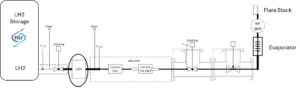

Accurate composition data are essential in custody transfer, where energy content determines traded quantities. Task 2.1 has collected reference data sets to support uncertainty evaluation. Since vaporisation-based analysis is widely used, Task 2.2 examines sampling as a key source of uncertainty, particularly during the transition from liquid to gas phase. The consortium published a report entitled “Report A 2.2.1: Literature review on the existing sampling systems including equipment such as vaporisers used in different facilities”. This report describes sampling systems for LNG specifically for the purpose of determining the composition of the LNG. Moreover, we outline how vaporisers can be used in different facilities (including LNG terminals, (bio-)LNG dispensing stations, trucks) and present information on how the equipment is connected to the facility and the type of connections. The document also informs about the different relevant standards related to LNG sampling for composition determination.
Density is determined either indirectly, using models such as GERG-2008 or Klosek–McKinley, or directly with instruments like Coriolis meters. Tasks 2.3 and 2.4 aim to validate both approaches and confirm that the target uncertainty can be achieved, strengthening confidence in LNG measurement practices.