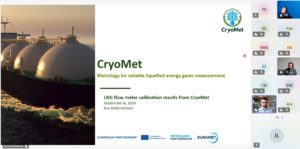

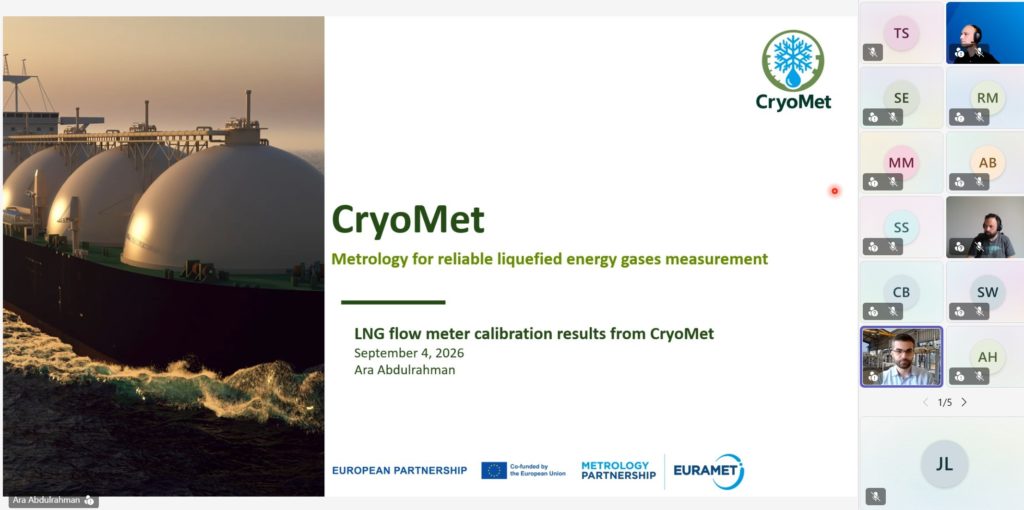
The CryoMet project organised the “LNG flow meter calibration results from CryoMet” webinar on September 4. The webinar served as a platform to present the results of our LNG flow meter calibration campaign and highlight the project’s contribution to advancing liquefied natural gas (LNG) flow metrology.
The session focused on a broad presentation of the results and the campaign by Ara Abdulrahman, Scientist for Flow Measurement at VSL National Metrology Institute. The presentation unveiled the methodology used during the campaign, brought to the table the results and sketched the next steps CryoMet will take in this aspect.
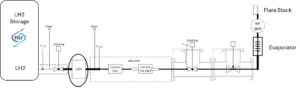
The calibration campaign was carried out at VSL’s LNG calibration facility, a dedicated infrastructure designed to characterise flow meters under cryogenic operating conditions. The facility enables controlled testing with LNG across the relevant flow and operating ranges, providing a robust basis for assessing whether improved accuracy targets can be achieved for LNG flow measurement.
The testing programme lasted for 3 days per flow meter, with different calibrations with LNG being tested in each one for the days. The first day, LNG was calibrated at 6 flow rates at -155 °C with external insulation, and one flow rate was repeated at -165 °C. The objective was to assess the achievable accuracy, compare the results with the water calibration, and evaluate the effect of temperature. The second day LNG calibration was carried out at six flow rates at −155 °C, again with external insulation of the flow meter. This test focused on assessing reproducibility and the effects of thermal cycling as the test line warmed up in between day 1 and day 2 calibrations. On the last day, LNG was calibrated at six flow rates at −155 °C without external meter insulation, and with one flow rate repeated at −165 °C. The objective was to evaluate the effect of external meter insulation and temperature on the calibration results.
Among the main results extracted from the testing, CryoMet indicates that a measurement accuracy of ±0.5 % with LNG is achievable, with the performance of the measurement standards being the main limiting factor. The tests also highlighted that zero-flow behaviour, insulation, diagnostic capabilities and the operating range are integral aspects of the measurement system and should not be considered secondary factors. Moreover, the testing programme demonstrated that cryogenic measurement performance must be experimentally validated and cannot be assumed based solely on water calibration results. Overall, the results show that proper calibration and commissioning are key to reliable LNG custody-transfer measurements.
CryoMet’s future work will focus on extending the results obtained from the LNG testing programme. This includes comparing the current results with previous measurements performed with liquid nitrogen and assessing their applicability to liquid hydrogen (LH₂) through extrapolation. In addition, meter performance will be validated under real operating conditions at an LNG terminal using Césame Exadébit’s CryoLDV standard. Further research will also include a comparison of available LH₂ flow-measurement standards and an assessment of the accuracy of density measurements provided by Coriolis meters. Further, CryoMet is evaluating the overall uncertainty associated with temperature measurements in liquefied-gas process conditions, and finally CryoMet is quantifying the sampling errors of LNG composition measurements.
After the presentation, webinar attendees and members of the CryoMet Stakeholder Advisory Board provided feedback on the results. Menne Schakel, Chief Scientist Flow at VSL and CryoMet coordinator, and Tamara Sarac, Project Officer at GERG – The European Gas Research Group, coordinated this last part of the webinar, which helped determine how useful the findings obtained during the campaign will be to the industry.
Remember that you can join the SAB by clicking the following link: https://cryomet.eu/contact/.