
Task 4.2: Determination of LH₂ isomer composition and its uncertainty
Hydrogen Speed-of-Sound Literature Dataset (Imperial College, Leibniz University Hannover)
As part of the CryoMet project, a comprehensive literature dataset of hydrogen speed-of-sound measurements has been published on Zenodo in support of Activity A4.2.1. The dataset compiles experimental speed-of-sound measurements for normal, para-, equilibrium, and composition-unspecified hydrogen reported in the scientific literature up to 2024. It covers a wide range of conditions, from cryogenic temperatures (~14 K) to above-ambient temperatures (~350 K) and pressures up to 100 MPa.
To facilitate reuse by the scientific community, the data are organised as Property Information Files (PIFs), grouped according to hydrogen composition and phase. The repository also includes a master summary index, a Python reader for straightforward data processing, and complete documentation describing the data structure and usage.
By making this curated dataset openly available, the CryoMet consortium supports transparent research, promotes FAIR data principles, and provides a valuable resource for the development and validation of thermodynamic models and SI-traceable hydrogen measurement methods
A New Reference Instrument for Cryogenic Hydrogen Speed of Sound Measurements at High Pressure
Significant progress has been made in Activity A4.2.3, where IC is developing a new experimental instrument for high-accuracy speed of sound measurements of hydrogen under cryogenic conditions.
The new apparatus will enable measurements at temperatures as low as 20 K and pressures up to 150 bar, providing the high-quality experimental data needed to validate thermodynamic models for liquid hydrogen. During the measurements, the hydrogen isomer composition (ortho- and para-hydrogen) will be monitored using Raman spectroscopy, ensuring that the equilibrium composition is maintained throughout the experiments.
The facility incorporates a state-of-the-art speed-of-sound sensor, advanced thermal management, and a highly automated control system designed for safe and reliable operation under extreme cryogenic conditions.
The data generated will contribute to the development of SI-traceable hydrogen property measurements, improving the accuracy of thermodynamic models and supporting the future deployment of hydrogen technologies across research and industry.
Task 4.3: Inter-comparisons of existing SI-traceable liquefied gas calibration standards
LH₂ Flow Measurement Facility and Intercomparison
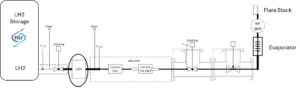
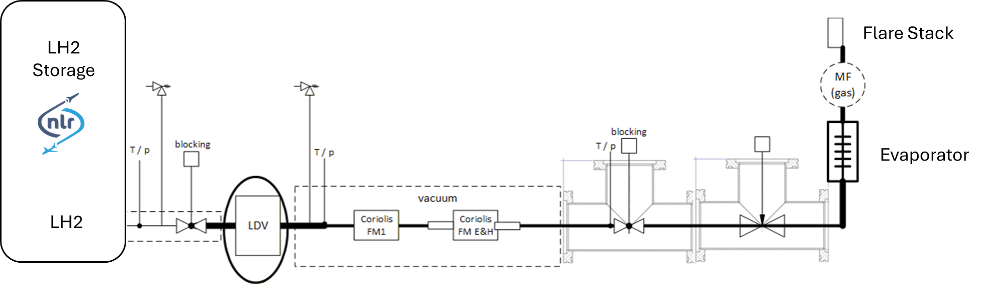
CryoMet partners are progressing the development of a new liquid hydrogen (LH₂) flow metering facility at the Netherlands Aerospace Centre (NLR) as part of Activity 4.3.1. The facility will provide a platform for the direct comparison of SI-traceable flow measurement standards at industrial flow rates.
Cesame’s cryogenic Laser Doppler Velocity flow meter-based SI-traceable standard and the Dutch National Metrology Institute’s (VSL) Coriolis flow meter-based transfer standard will be compared. The comparison is performed to cross-validate the calibration capabilities of the LH2 flow measurement standards.
Current work focuses on the detailed design of the facility, including the hydrogen infrastructure, instrumentation, vacuum-insulated test section, and measurement protocols. Procurement and coordination activities are underway, while the measurement campaign is planned for 2027.
By establishing this dedicated LH₂ flow metering line, CryoMet will contribute to the development of reliable, SI-traceable LH2 flow measurement methods, supporting the growing hydrogen economy and future calibration services for cryogenic hydrogen applications.
Comparison of SI-traceable LNG composition measurement facilities
EffecTech and VSL recently completed the LNG composition measurements needed to compare their SI-traceable LNG composition measurement facilities. The study compares the two partners’ reference measurement facilities, using a Raman probe as an independent cross-validation tool.
The project has now entered the data analysis phase. Recent activities focused on developing a method to compare the two facilities while LNG compositions were different. Additional discussions between the partners are underway to finalise the analysis and reporting
This work will further contribute to establishing Raman spectroscopy as a reliable technique for the composition analysis of liquefied natural gas and support future SI-traceable calibration procedures.